Witness to Murder (1954)

Witness to Murder
Watching Witness to Murder, I couldn’t help but think Rowland was riffing off of Rear Window, except when I checked the release dates. Witness to Murder came out several months before Hitchcock’s film. There was also a scene that reminded me of the famous bell tower sequence in Vertigo, yet the latter came out a full four years after Witness. I’m not saying with any certainty that ole Hitch was cribbing notes from Rowland, but I would be surprised to learn he never saw this noir thriller starring Barbara Stanwyck and George Sanders.
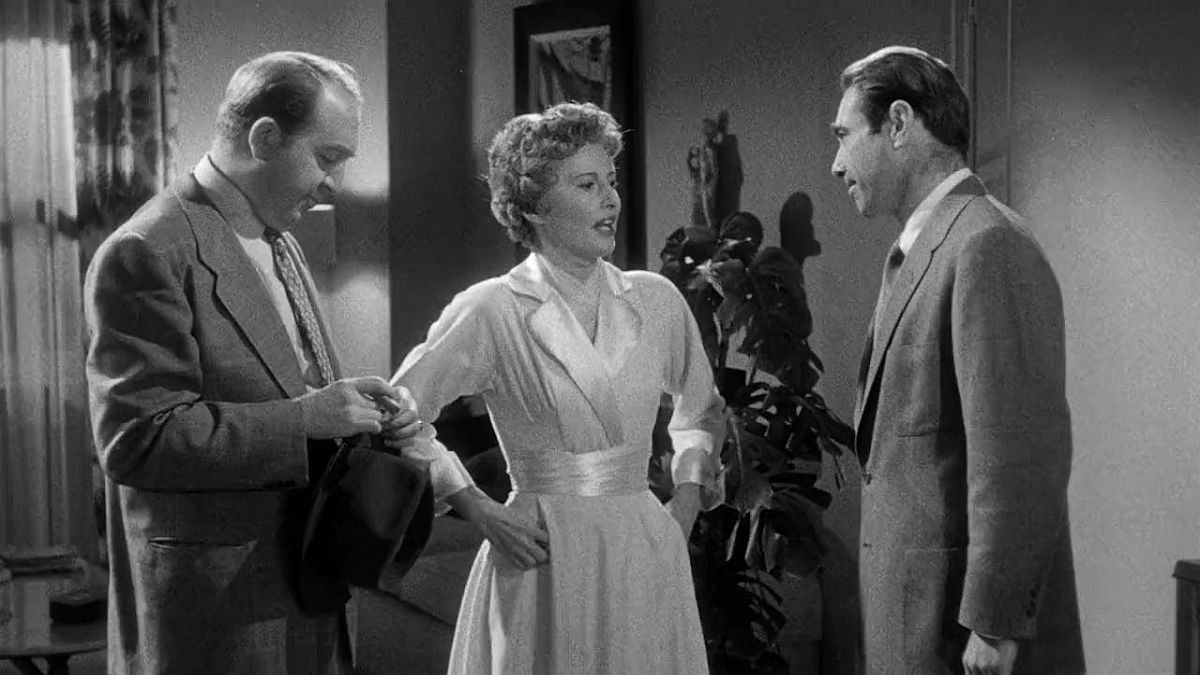
The film follows Cheryl Draper (Stanwyck), a woman who looks out her window late one night and sees a man strangling someone in the apartment across the way. She reports it immediately, but by the time the police investigate, the body has vanished and the killer has covered his tracks. Cheryl becomes increasingly determined to prove what she saw, even as the murderer, Albert Richter (Sanders), begins manipulating the situation to make her look unreliable. The more she pushes, the more isolated she becomes, caught between her own certainty and everyone else’s doubt.
This is where the comparison with Rear Window becomes interesting. Hitchcock’s movie is playful and voyeuristic, built around a protagonist who is immobilized and bored, almost stumbling into danger by accident. Witness to Murder is more direct and less stylized, driven by Cheryl’s active pursuit of the truth rather than passive observation. Where Rear Window toys with ambiguity, Rowland’s film builds on the tension of knowing the threat is real while watching the world refuse to acknowledge it. The suspense doesn’t come from guessing whether Cheryl is right, but from waiting to see if anyone else will believe her.
That disbelief ties into one of the film’s most prominent themes. Cheryl is treated as hysterical, overwrought, or simply confused, and the men around her default to the assumption that she must be imagining things or that she is outright delusional. The film taps into a long tradition of dismissing women’s testimonies, especially when they challenge a seemingly polished, respectable man like Richter (who happens to be a known Nazi, but it’s okay because he’s been denazified. Yikes). Stanwyck plays Cheryl with a mix of vulnerability and resolve that makes the gaslighting feel especially sharp.
For all its familiar noir elements, Witness to Murder remains a lesser known entry in the genre, overshadowed by the giants it unintentionally echoes. Still, it is a lean, engaging thriller with a compelling lead performance and a surprisingly modern thematic edge. Anyone who enjoys classic noir or wants to see the film that may have quietly influenced Hitchcock should give it a spin.