The Shrouds (2024)
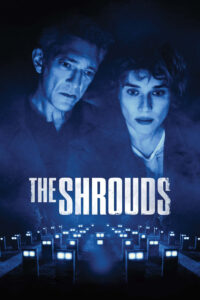
The Shrouds
It has only been two years since the release of Crimes of the Future (2022), so it genuinely feels as though David Cronenberg has slipped back into a creative flow. The eight-year gap between Maps to the Stars and Crimes had many wondering whether he was slowing down, but The Shrouds suggests the opposite.
THIS REVIEW CONTAINS MINOR SPOILERS
The film centers on Karsh (Vincent Cassel), a wealthy entrepreneur still reeling from the death of his wife, Becca (Diane Kruger). His mourning is not passive; instead, it becomes a motivating factor for invention. Driven by a desire to maintain a connection with his dead wife, one that is more “intimate” than traditional mourning rituals allow, Karsh develops GraveTech, a radical new technology that enables the living to monitor the decomposition of their loved ones’ bodies in real time. It’s a concept that is both voyeuristic and unsettling, which is precisely the kind of terrain Cronenberg thrives in.
When a series of graves in Karsh’s high-tech cemetery are mysteriously vandalized, the narrative shifts into a paranoid thriller. Karsh becomes entangled in a web of international conspiracies, possible corporate sabotage, and the increasingly opaque world of digital surveillance. The deeper he digs, the more the film blurs the line between external threat and internal unraveling. Is Karsh uncovering a genuine plot, or is he projecting his unresolved grief onto a world he no longer trusts?
Soo-Min (Sandrine Holt) enters the story as a prospective client, seeking GraveTech access for her terminally ill husband. Her initial interactions with Karsh are formal, even guarded, yet there’s an undercurrent of curiosity on both sides that gradually pulls them into a more intimate, uneasy relationship. As Karsh’s paranoia deepens, Soo-Min becomes another uncertain variable. Their connection is tinged with desire, suspicion, and the possibility that she may be a player in the very conspiracies he fears.
The film also plays with doubling through the presence of Becca’s sister, Terry (also played by Diane Kruger). Terry’s resemblance to Becca is not merely a visual echo; it becomes a psychological pressure point for Karsh. Their interactions are brimming with unresolved grief, latent desire, and the uncomfortable sense that Terry may be using her likeness, whether intentionally or not, to manipulate Karsh’s vulnerability. She is both a reminder of what he’s lost and a destabilizing presence who complicates his investigation into the grave vandalism. Terry’s involvement in the unfolding mystery adds another layer of uncertainty: is she protecting her sister’s memory, pursuing her own agenda, or simply caught in the gravitational pull of Karsh’s fixation? Cronenberg uses the doppelgänger motif to heighten the film’s themes of identity, projection, and the ways grief can affect perception.
As expected, The Shrouds revisits many of Cronenberg’s signature preoccupations. The intersection of technology and the flesh, the boundary between desire and decay, and the psychological strains that arise from loss all take center stage. There are moments of visceral body horror, but they’re woven into a broader meditation on mortality and the ways we attempt to control or inoculate our understanding of death. The film’s erotic undercurrents – uneasy and darkly psychological – echo Cronenberg’s earlier work while feeling newly relevant in an era obsessed with data, surveillance, and the commodification of intimacy.
In the end, The Shrouds feels like a filmmaker connected to his roots who is still pushing into new emotional territory. It’s eerie, cerebral, and unmistakably Cronenberg.