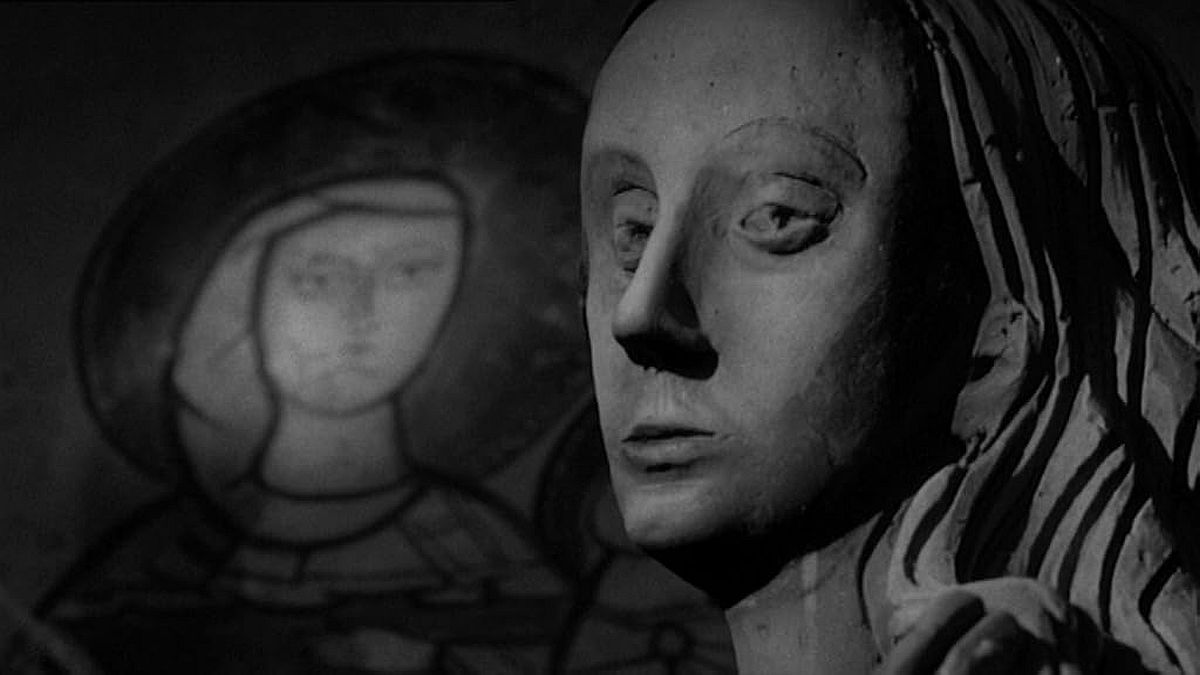
Anchoress (1993)

Anchoress
Anchoress (1993) is a somber, meditative film that blends historical drama with a dreamlike quality. Set in 14th-century England, it follows the young peasant Christine Carpenter (Natalie Morse), whose intense visions, experienced as direct communications with the Virgin Mary, lead her to become an anchoress. She is literally walled into a cell adjoining the village church, a space constructed within a small Marian devotional sanctuary that houses a revered statue of Mary. Within this enclosure, she is meant to devote her life entirely to prayer. The film traces her journey from spiritual fervor to confinement, revealing how her mystical aspirations collide with the social, religious, and gendered constraints of medieval life.
The historical setting is more than backdrop; it shapes every tension in the story. In a world where the Church dominates intellectual and moral authority, personal visions like Christine’s occupy an uneasy place, provoking both fascination and fear. Newby’s minimalist style underscores how fragile the boundary is between sanctity and suspicion. Christine’s desire to transcend the physical world, her body, her sexuality, and her worldly obligations reflects a genuine medieval longing for spiritual purity. Yet the film never lets us forget that such aspirations emerge within a rigid hierarchy that polices who may speak for God.
This hierarchy is embodied in the priest (Christopher Eccleston) and bishop (François Beukelaers), whose authority rests not on direct ecstatic experience, but on institutional power. Their interactions with Christine reveal a deep contradiction. They want her visions to validate the Church’s authority, but they are also disquieted by the unruliness of a woman who claims direct access to the divine. In contrast, Christine’s mysticism feels raw and embodied, rooted in an experiential connection with the numinous rather than a dry adherence to doctrine. Her visions don’t conform to established tradition. They unsettle rather than affirm. The film uses this contrast to question who gets to define holiness and whose spiritual experiences are deemed legitimate.
Christine’s mother Pauline (Toyah Willcox) adds another layer to this dynamic. Skilled in folk remedies and rural healing practices, she occupies a liminal space, where she is respected by some villagers, distrusted by others, and viewed with contempt by Church officials. Her knowledge of the body and the natural world stands in opposition to the Church’s emphasis on otherworldliness. The tension surrounding her reflects broader medieval anxieties about women’s knowledge, especially when it fell outside sanctioned religious structures.
By weaving together these threads of mysticism, authority, the body, and the precarious position of women, Anchoress becomes a philosophical exploration of how spiritual yearning can be a refuge and a trap, shaped as much by personal vision as by the forces that seek to contain it.