The Bride from Hades (1968)

The Bride from Hades
Drawing from the classic kaidan Botan Dōrō (The Peony Lantern), The Bride from Hades offers a restrained yet emotionally charged retelling of one of Japan’s classic ghost stories. Rather than leaning on shock or spectacle, the film highlights human frailty, social pressure, and the passion of seduction — themes that give this adaptation a distinct sense of melancholy.
The story centers on Hagiwara Shinzaburō (Kōjirō Hongō), a young samurai who rejects his family’s political maneuvering, particularly their insistence that he marry his late brother’s widow Kiku (Atsumi Uda). Choosing principle over privilege, he abandons his aristocratic household and takes up residence among the common row houses, where he teaches local children to read and write. It’s a mostly ascetic life, until the Obon Festival begins.
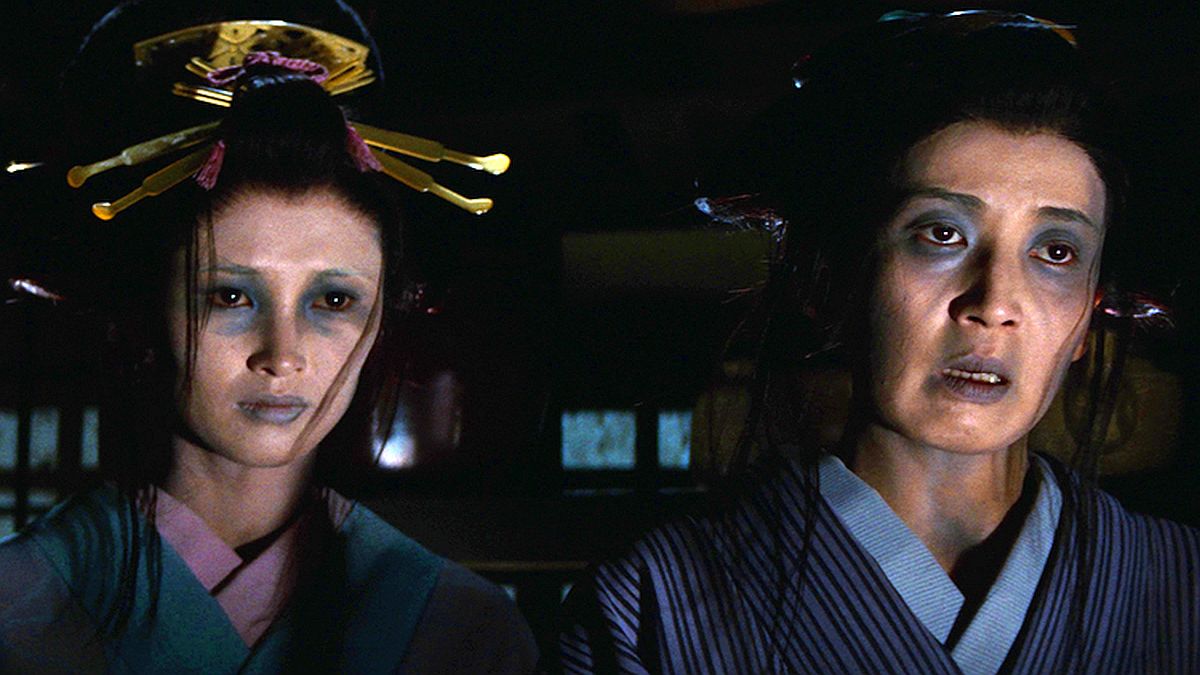
On the festival’s first night, Shinzaburō encounters the ethereal Otsuyu (Miyoko Akaza) and her loyal attendant Omine (Mayumi Ogawa). Their meeting unfolds with a dreamlike tenderness, and Yamamoto emphasizes the romance more than many adaptations do. The film treats Otsuyu not as a malevolent spirit but as a tragic figure whose yearning mirrors Shinzaburō’s own emotional exile. When the town drunk Banzō (Kō Nishimura) later claims he saw Otsuyu leaving Shinzaburō’s home, his friend Hakuôdō (Takashi Shimura) dismisses the idea – Otsuyu, after all, has been dead for months.
This version of the tale introduces a social critique through the subplot involving Banzō’s wife, Oume (Yoshiko Mita). Oume’s scheming – demanding 100 ryū from the ghosts in exchange for removing the protective seals placed by the high priest – inserts a note of human corruption that contrasts with the purity of Otsuyu’s devotion. Her greed becomes a commentary on the living, suggesting that the true moral rot lies not with the dead but with those willing to exploit them.
Where earlier tellings of Botan Dōrō emphasize moral punishment for forbidden desire, Yamamoto reframes the narrative as a lament for love constrained by circumstance. The result is a haunting, lyrically mournful film that emphasizes two lovers drawn together across worlds that cannot coexist.