The Ceremony (1971)
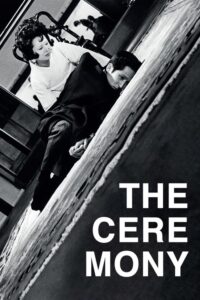
The Ceremony
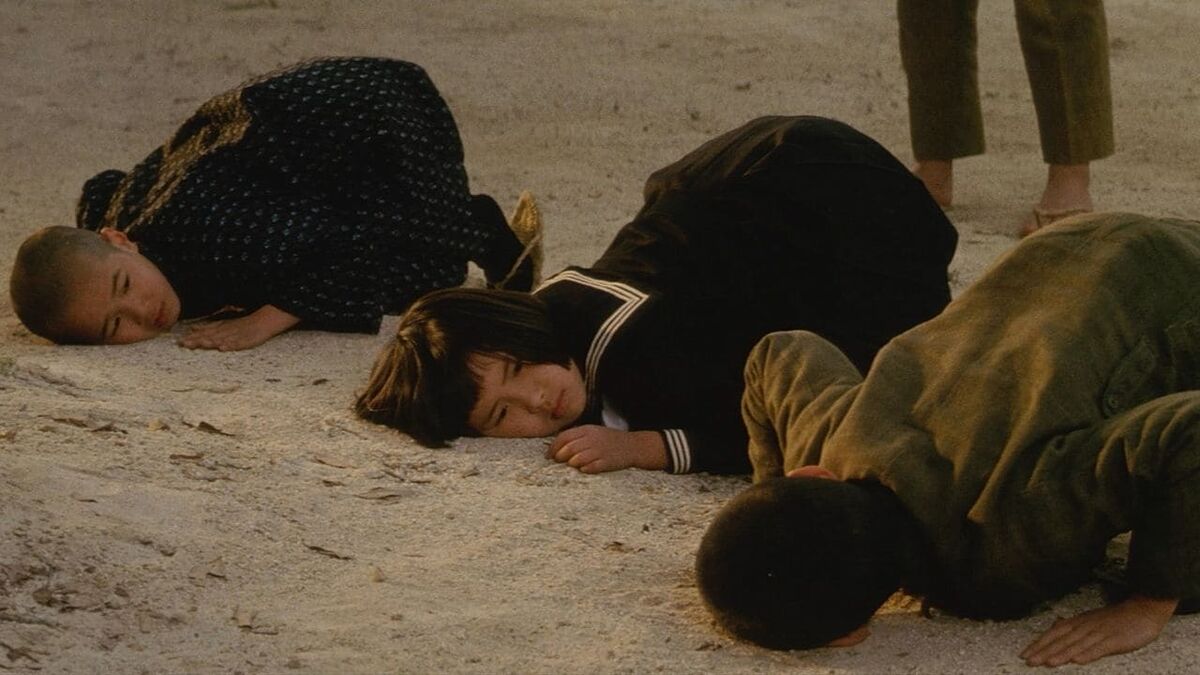
The Ceremony utilizes a frame story based on Sakurada Masuo (Kenzō Kawarasaki) receiving a telegram from his cousin Terumichi (Atsuo Nakamura) announcing his own death. Masuo and his other cousin Ritsuko (Atsuko Kaku) are traveling to Terumichi’s home to verify the truth of the message. The film includes a variety of flashbacks from Masuo; memories about significant events from his life that span from the time he was a boy, when he and his mother were sent to the Sakurada family during the repatriation from Huludao in the early postwar period, up through and including his young adulthood.
The nonlinear narrative loops around a series of formal ceremonies of the Sakurada family, such as funerals and weddings. What unfolds is an intricate and emotionally sophisticated tale that reveals the complex and often turbulent relationships between the family members while also serving as social commentary about Japanese culture, politics, and identity in the aftermath of World War II. This two-pronged approach – the personal and the social – intensifies the emotional weight of the film, offering a layered critique of nationalism, conformity, xenophobia, and the psychological impact of inherited patriarchal expectations.
Within Nagisa Ōshima’s body of work, The Ceremony extends the director’s sustained interrogation of postwar Japanese society, aligning closely with the politically charged films he made in the late 1960s and early 1970s. Works such as Death by Hanging (1968), Boy (1969), and The Man Who Left His Will on Film (1970) similarly confront the failures of state power, the lingering shadows of imperialism, and the instability of personal identity in a society struggling to redefine itself. Like those films, The Ceremony uses formal experimentation such as nonlinear structure, symbolic repetition, and abrupt tonal shifts to expose the contradictions embedded in Japan’s postwar narrative of recovery and unity.
At the same time, the film stands in contrast to Ōshima’s earlier crime and yakuza-based works, including Pleasures of the Flesh (1965), Violence at Noon (1966), and Double Suicide: Japanese Summer (1967). Those films channel social critique through transgressive sexuality, criminality, and eruptions of violence, often focusing on individuals pushed to extremes by repressive social forces. Whereas The Ceremony turns its gaze inward, toward the suffocating rituals of a powerful family whose rigid adherence to tradition becomes its own form of violence. Rather than depicting rebellion against the social order, Ōshima discloses how the order itself, with its hierarchies and inflexible rules, produces trauma across generations.
The result is a controlled yet devastating film, a work that synthesizes Ōshima’s political concerns with an examination of how families and nations alike use formality to mask their deepest wounds.