Children of Time (2015)
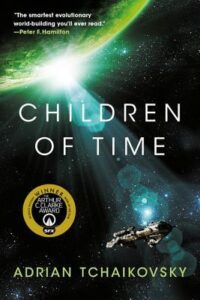
Children of Time
Big-Idea science fiction is back, and I’m so here for it. Children of Time is my introduction to Adrian Tchaikovsky. It is also the first book of a series by the same name, which currently runs to four volumes.
The story consists of two alternating threads. The first tells of humanity’s struggle to survive after a catastrophic collapse on Earth. The remnant humans travel through deep space in an ark ship in search of planets that were terraformed by their ancient ancestors, to determine if any of those planets are inhabitable. The second thread tells the story of an alien species that was the result of an uplift experiment that took a different direction than was initially intended. These two species (the remnant humans and the aliens) inevitably encounter one another, overturning previously held understandings of biology, intelligence, and civilization for both.
One of the novel’s most intriguing themes is its treatment of time. The humans aboard the ark ship don’t experience time as a continuous flow but as a series of fractured awakenings. Centuries pass while they sleep in suspension, yet for those periodically revived to solve crises, these vast stretches of history compress into a handful of disorienting moments. This fractured existence gives them an alien-like relationship to memory and identity. Upon each awakening they are confronted with a world that has moved on without them. Tchaikovsky uses this disjointed flow of time to explore how civilizations evolve, and how individuals struggle to remain whole while their lives carry on in discontinuous leaps.
This theme of time, and the resulting effects on memory and identity, is simultaneously explored in the second thread through the perspective of the aliens. As chapters of the book flip back and forth between the humans on the ark ship and the creatures on one of the terraformed planets, centuries go by, with generations of the life-forms on the planet arising and passing away, and their societies transforming and evolving in various ways.
I loved the way alien consciousness was described in vivid and intricate detail, including how they communicate, how the hierarchies of their societies are constructed, and how they perceive their world through their senses. All fantastic. Tchaikovsky was able to lure me into a way of being that is completely foreign to my own. That takes skill.
Children of Time is the kind of science fiction that stretches my imagination and challenges my assumptions. Tchaikovsky balances grand cosmic scale with meticulous biological and cultural detail. By the end, the novel left me contemplating forms of intelligence, different ways life adapts, types of motivation that drive civilizations, and the nature of time and memory. It’s an ambitious, imaginative work. I’m excited to continue with the rest of the series.